Live Notes from Inside the Vibe Coding Token Casino
Where every build gets you a dopamine high but you forget to check the balance.
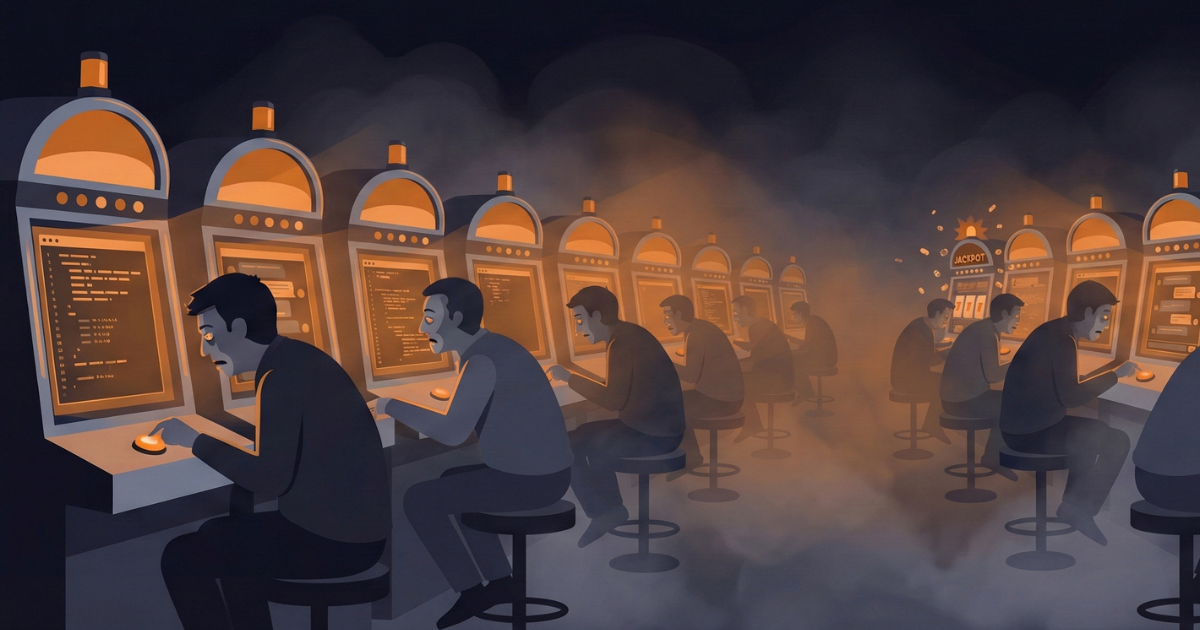
I’ve been noticing something. My GitHub feed is full of new open source tools that solve roughly the same problem. Agent frameworks, orchestration layers, workflow builders. They’re all impressive. Genuinely good work by talented developers. And they all landed within weeks of each other.
I don’t think that’s a coincidence. I think it’s a signal of something worth paying attention to.
Everyone’s Building the Same Thing
Here’s what I think is happening. AI-assisted coding has gotten good enough that all knowledge workers can finally scratch their own itch. That side project you’ve been thinking about for two years? You can build a working version in a weekend now. The tool that almost does what you need but not quite? Fork it, rewrite the parts that bother you, ship it.
That’s genuinely great. You learn by building. You understand a problem domain deeper when you’ve implemented a solution yourself. The personal value is real.
But I’m starting to notice a pattern. A lot of these tools overlap. Not because anyone is copying anyone else. Because when you give thousands of capable people the ability to build whatever they can describe, they describe similar things. The problems that are obvious enough to articulate clearly are, by definition, obvious to everyone.
Pull the Lever Again, and Again
I’m writing this partly as a note to myself. I’ve been deep in the vibe coding loop. Start a session, describe what I want, watch it materialize, ship it, feel the hit. Next thing. And the next. It’s genuinely addictive.
There’s a slot machine quality to it. Pull the lever, see what comes out. Good result? Pull again. Even better. The feedback loop is so tight that you can spend an entire evening building things and feel incredibly productive the whole time.
But lately I’ve been catching myself mid-session and asking: is this actually useful? Not “does it work” — it works, that’s the easy part now. Useful. As in: would anyone pay for this? Does this solve a problem that isn’t already solved? Or am I just keeping myself busy in the most stimulating way possible?
I don’t always like the answer.
Learning Isn’t a Business Model(?)
Here’s where I’m trying to be honest with myself. On a personal level, vibe coding is valuable. I’ve learned more about software in the last few months than in the years before. Building things — even things that already exist — teaches you how they work. That has real worth.
The risk is in the extrapolation. Taking that personal learning high and assuming it translates to economic value. Assuming that because you built it, and it works, and it felt productive, that it matters in the market.
Because the market doesn’t care about your journey. It cares about whether your solution is better, cheaper, or more accessible than the other twelve that shipped this month.
There’s an 18-year-old out there with a Claude subscription, endless energy, a programming background, and nothing to lose. They’re building the same things I am. Probably faster. My only edge on them is I’ve got more exposure to real business problems, but to be fair a lot of the vibe coding I’ve done has been on rather generic business backend automation…
The Fork in the Road
I’m not sure about any of this yet. But here’s the thesis I’m working toward.
The AI unlock is exponential. If you point it at linear problems — the next task on your list, the workflow that annoys you, the tool that doesn’t exist yet — you’ll ship things. Fast. And it’ll feel amazing.
But the problems that are easy to describe are easy for everyone to describe. The more contained and well-defined the problem, the faster the solution space gets crowded. Not because people are lazy. Because everyone is talented and motivated and equipped with the same tools.
The problems that might actually hold their value are the messy ones. The ones that span domains. Physical and digital. Technical and human. Where you can point AI at individual pieces, but connecting them still requires context that doesn’t fit in a prompt.
I’m not saying this from a position of having figured it out. I’m saying it because I catch myself at 11 PM building something I know three other people open-sourced last Tuesday, and the honest question is: why am I doing this? Because I’m learning? Great, own that. Because I think it’ll be a business? That deserves a harder look.
What Am I Actually Winning?
“Vibe coding” (or rather, using AI) is going to be a normal part of how everyone works. Like electricity — you’ll use it whether you think about it or not.
The question I’m sitting with is: what am I actually pointing it at? And is the answer “the obvious thing in front of me” because that’s where the dopamine is?
I don’t have a clean conclusion here. I’m still in it. But I think the most useful thing I can do right now is notice the pattern and name it. The vibe coding casino is fun. The lights are great. The wins feel real.
I’m just not sure yet what I’m actually winning.