What Is Cognitecture (And Why I Started This Blog)
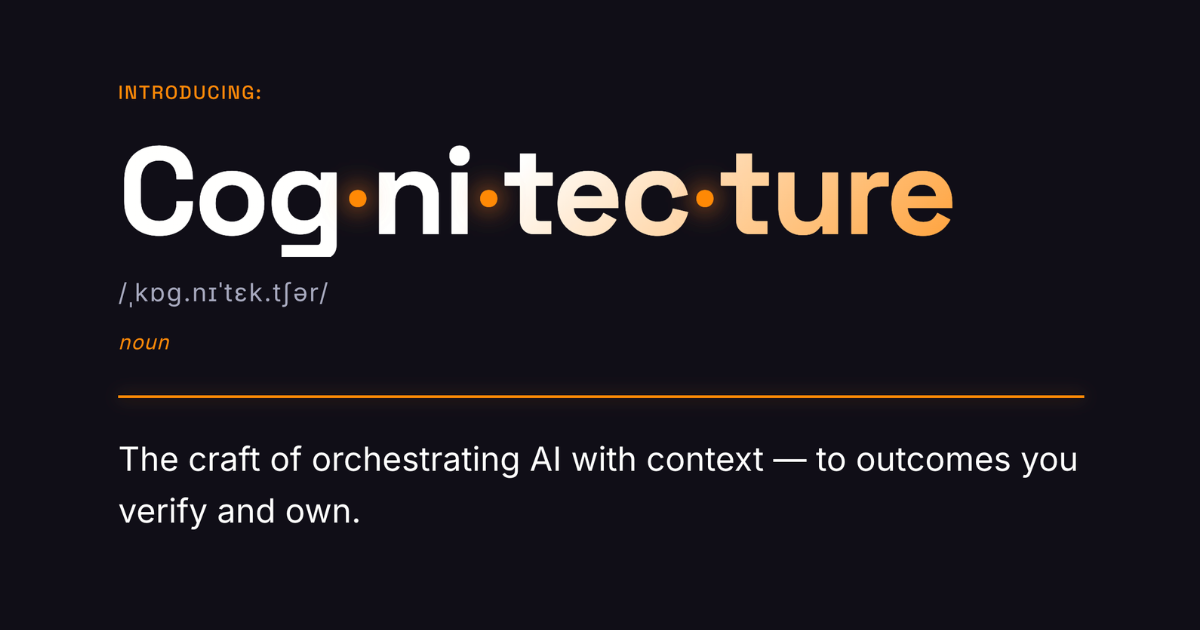
Introducing cognitecture — orchestrating AI with context to outcomes you verify and own.
The person taking your job won’t be better than you — they’ll just know how to direct the thing that is.
Cognitecture — the craft of orchestrating AI with context, to outcomes you verify and own. Cognition + architecture. A cognitect is someone who practices it. Not a job title — a way of working.
I wrote a full manifesto at cognitecture.org. This post is the backstory.
What made me name this
The last four months of my work as a marketing analytics consultant have been fundamentally different. A client with fifteen data sources — I single-handedly built all ingestion pipelines, transformations, and dashboards. What used to require a team and months, I delivered alone in weeks.
The same pattern showed up everywhere: strategy docs, proposals, competitive analysis, internal tooling. Every domain where I had enough context to evaluate the output became a domain where agents could multiply my work.
The work holds up not because the agents are good. It holds up because I understand the business well enough to catch when something’s off. The agents handle implementation. The judgment comes from experience.
What changed wasn’t just speed — it was scope. The ceiling on what one person can deliver moved dramatically. That realization made me want to name the practice.
The core thesis
AI output is bounded by the context it has access to. The bottleneck shifted from execution to context, judgment, and trust. The cognitect’s job is knowing what context matters, how to structure it, and how to verify agents are using it correctly.
The manifesto unpacks this into five disciplines (DROIT) that remain human — direction, rigor, ownership, integration, taste — and a seven-step loop for how the practice actually runs day to day.
Why this blog
Writing forces you to codify what you actually understand versus what you’re pattern-matching on vibes. This blog is my scratchpad for the journey.
Two pillars:
- Practice — concrete patterns, tools, workflows for working with AI agents on real projects.
- Perspective — what changes when execution gets cheap and judgment gets expensive.
Not interested in benchmarks, hype cycles, or breathless product launches. Interested in what works when you have to ship something real and put your name on it.