What Is Cognitecture (And Why I Started This Blog)
Cognitecture means bounded delegation: AI agents act under independent checks, a named owner, clear limits, and a way back when things fail.
Generating plausible work is cheap. Deciding what to delegate and owning the result is hard.
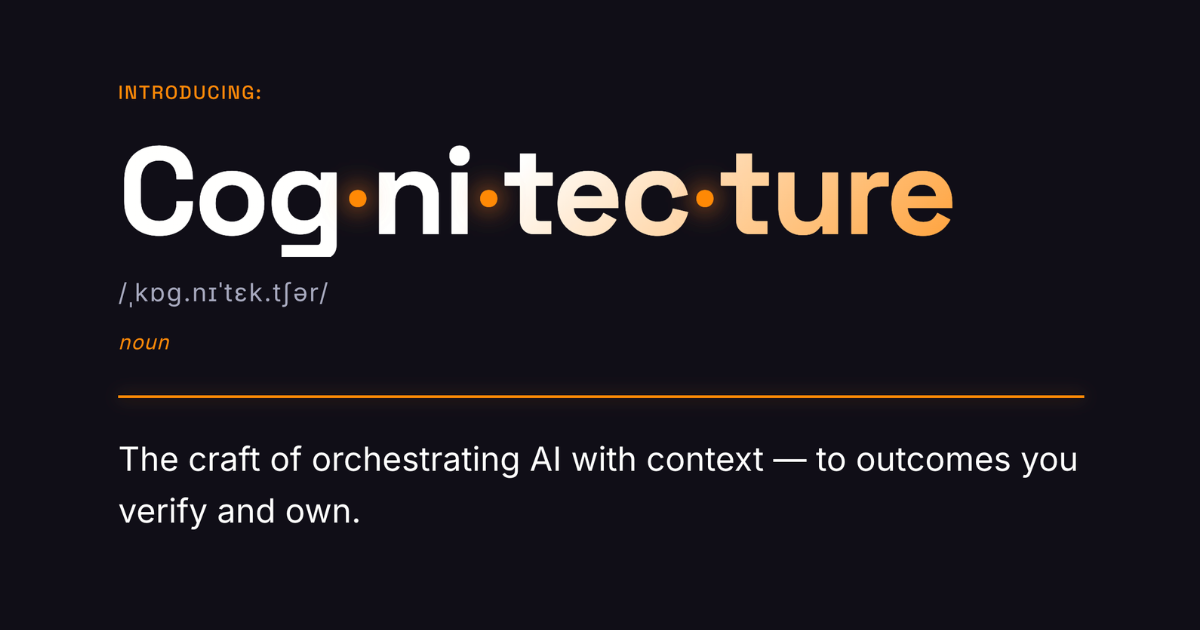
Cognitecture is bounded delegation: directing AI agents from context to real-world outcomes with independent checks, a named owner, and a way back when they fail. Cognition + architecture. A cognitect practices it. The word names a practice, not a job.
The v7 manifesto at cognitecture.org gives the full case. This post tells how it started.
What made me name this
Over the last four months, my work as a marketing analytics consultant changed. For one client, I single-handedly built all pipelines, transformations, and dashboards across fifteen data sources. By my estimate, a team would take months (the counterfactual was never run); I did it alone in a fraction of the time.
In other structured work, agents expanded what I could attempt when I had context and could verify the result.
My business knowledge lets me spot errors and verify them against reality. Agents generate and implement; evidence makes the result dependable.
Agents changed my speed and scope. One person could attempt far more. This is a demonstration, not proof that every domain is equally solvable.
The core thesis
Candidate work is cheap across a growing but jagged set of tasks. Dependable outcomes still take work. Rich context and fast feedback show technical feasibility, nothing more.
Cognitecture starts with five questions:
- What may be delegated?
- Under what evidence?
- With whose authority?
- Within what blast radius?
- With what recourse?
Write the answers as an autonomy warrant: a revocable grant of scope, independent evidence, limits, authority, escalation, recovery, and expiry. Autonomy grows with evidence, not confidence.
The DROIT disciplines carry the warrant: Direction, Rigor, Ownership, Integration, and Taste. Agents can help with all five. When consequences require answerability, deployment stays under a human owner who can observe, stop, explain, repair, and provide recourse.
Why this blog
Writing shows what you know and what you merely repeat. This blog is my working notebook.
Two pillars:
- Practice: tools and workflows for real agent work.
- Perspective: what cheap execution does to costly judgment.
I care about what works when you must ship something real and own it. Benchmarks, hype, and launch chatter can wait.